Home Systems
know it's ok. When no one is there, it's like we want to know what's going on at home. When we leave for work or for a few days or on vacation, worries increase, especially if it's a household.
If we also think about how many homes are uninhabited for long periods of time, or if we have a house in the country or on vacation, things get even more complicated.
If there were "someone" - something - in the house, permanently, that we could call or notify us about everything that happens, if we could control it at a maintenance cost as low as a light bulb, it would even be interesting. Something like this has already been done, and electronica-project.net in this section will offer an introduction, to understand and familiarize yourself with the basic terms used and to prepare you for those interested in this field.
Such a system is designed and thought for the average person, not for specialists and the explanations are understandable to everyone.
We propose to take them one by one.
What is an integrated home automation system, in the context of current technology
It is a device that does not take up more space than a regular PC-desk. It is preferably not kept in sight. It is smart and only does what it is told to do; it does not take control, it does not disturb. It knows how to collect information from the entire home or household, processes all this information and makes the decisions that the owners/family members of the home want. It communicates with them permanently, so that it can intervene anytime and from anywhere. The connections of this equipment lead to sensors, home switches, servomechanisms and electrical actuators, where it is desired to act or collect information; this means integrated system, meaning it has all four types of inputs and outputs together in the same system, described here on this web page. The electrical installation of the home is not modified. All the peripherals of the system are added to what already exists without modifications. The equipment is supervised via the internet and optionally communicates via the mobile telephone network, GSM. The equipment has an identity and ensures total control over the home.
How do we communicate with such equipment
With your own computer or mobile devices. We simply "call" this device, which takes care of our home, it may be, it calls us first to inform us that it has performed an action or received information; for example, the birds in the yard have been fed and the flowers have been watered......
If we want to perform some commands/actions in the house, to read certain parameters that interest us, in the house installation, or to program certain actions in the home, we have everything at hand, on the control panel provided by the system.
But let's detail a little by sections of the control panel, the elementary commands that are available to us.
1. Digital outputs
To turn on a light bulb in the house, unlock a lock or operate a water solenoid valve, the equipment has a relay controlled by the system, on whose contacts the respective light bulb, lock or solenoid valve is connected. That is, the command to turn on the light bulb comes from the system, it activates the relay which in turn closes its contacts to make the light bulb light up. The information and action to turn on the light bulb, exit the equipment to the light bulb. It is what is called in technical terms, digital output. It has electrical contacts that control devices, also electrical, but from outside the equipment.
If we want to operate a light bulb, an electric latch and a solenoid valve, this means that we need three digital output channels.
On the control panel, a digital output is found in the form of a mouse-activated ON/OFF button with a click. The meaning of the buttons is set in the settings window of the digital outputs page.

© Copyright by DomoTicSys®tem Technologies. All rights reserved.
2. Digital inputs
To know if a gate, a door, a pressure switch or a stroke limiter are closed or open, microcontacts, microswitches are used, whose contacts are connected to certain connectors in the equipment. Because the information to close or open comes from outside the equipment and enters the system, we will call that connector as intended for digital inputs. If we have a gate, a door, a pressure switch and a stroke limiter, this means that we need four digital input channels.
On the control panel, we find them in the form of markers with a more special design. The empty space inside the marker indicates that nothing has happened. The appearance of a distinctive filling sign signifies a change in position, the occurrence of an event, an electrical contact made. The meaning or destination of the channel next to the markers is set from the settings window of the digital inputs page.

© Copyright by DomoTicSys®tem Technologies. All rights reserved.
3. Analog outputs
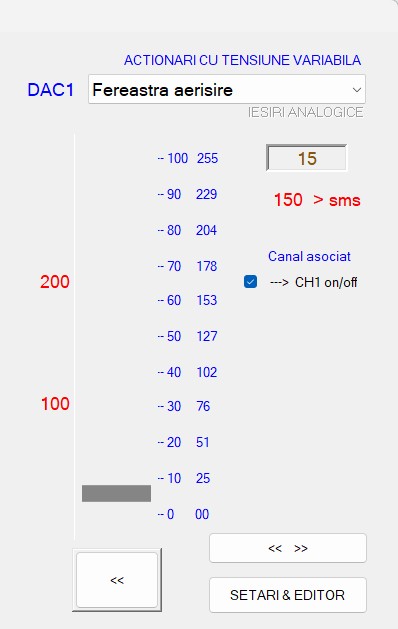
It is an output of the equipment, a voltage to the outside but a variable voltage, at the user's disposal through which servomechanisms can be controlled, for mechanical actuation, for example, on blinds, opening a window or rotating a device.
These actions/movements are performed from the control panel, by moving the cursor of a scroll bar up or down, as in the figure below.
© Copyright by DomoTicSys®tem Technologies. All rights reserved.
4. Analog inputs
In order to know the environmental changes or the modification of some parameters of interest in the house installation, the control panel is equipped with digital displays, on which we can read these parameters.
Electrical quantities that are constantly changing are measured, that is, analog values given mainly by specialized sensors, whose lines are connected to a specific connector in the equipment. The information measured by the sensors goes to the equipment and enters the system to be processed and displayed. Because it is an analog value, changing such as temperature, pressure, linearity, position, etc. and the measured quantity enters the equipment, we will call that connector, analog inputs.
How many parameters we want to measure, how many channels we need. It is simply read on the digital display, the measured value that interests us, from the channel dedicated to the purpose for which the respective sensor was attached.

© Copyright by DomoTicSys®tem Technologies. All rights reserved.
Programming or system intelligence
Home automation is an information collection system, using all four types of inputs/outputs, from the home and the surrounding area or yard.
Taking each piece of information separately or a group of information, the homeowner/family member can dispose of it as they wish: to view it, to read it simply for information, or to combine them together, in a pre-established and autonomous program, requiring it to communicate permanently, informing them of changes in the situation.
In this way, any event that occurs in the home space is brought to the attention of the owner/family member, who can have total control over the situation.
________________________________________________________________________________________________________________________________
"Domotics is an application of computers and robots for household equipment. ........ Domotics is a science of the future that aims to make human life as comfortable as possible.
The building of the future, be it a home or the space in which we spend time during the working hours, is the object of meticulous analysis and research for many fields of activity.
Most people spend most of their time indoors and therefore the future imposes the "smart building" as a necessity, not a luxury.
The approach to a "smart building" has reached the level of systemic approach, integration and interoperability and integrates the concept of optimizing energy consumption with safety, security, comfort and communications. The evolution in the industry of equipment used in process control is in full maturity and is based on the principle of interoperability. In some works, this type of buildings appear under the name of buildings with intelligence quotient. We are used to calling them smart buildings, although their IQ actually resides in the way in which the systems of any kind existing in these constructions are controlled. ........ But the international trend is that of interconnecting these buildings. We will witness, in the opinion of specialists, the birth of true smart cities.
In a traditional building, individual systems are controlled independently, and their parameters do not affect each other. A building can be called intelligent when the control of its systems is integrated, and decisions are made based on a set of data. In fact, it is not the building that is intelligent, but the way its systems are controlled."
Extract from the document: "DOMOTICA", "Dunarea de Jos" University Galati, Faculty of Electrical and Electronic Engineering
_____________________________________________________________________________________________________________________